
OEM/ODM Jewelry Manufacturing and the 100% Inspection Rule
The inspection rule is simple to state: every piece is checked, not a sample of the batch. Published as 100% inspection, it sits between the plating tank and the packing bench, which is the narrowest point in the whole eight-step process. Minimum order quantities are 100 pieces in eco-brass, 100+ in stainless steel and 50 in sterling silver, counted per design quoted per design.
Key takeaways
- 100% inspection means every finished piece, not a statistical sample, is checked before packing.
- The check sits after electroplating and before branded packaging, so plating defects are caught on site.
- Master sampling is 25–30 days and covers five bench operations in sequence.
- Minimums of 50 / 100 / 100+ pieces per design apply by material, and the mould stays exclusive to your brand.
Why 100% and not a sampling plan
A sampling plan tells you what fraction of a batch is probably acceptable. A full inspection tells you which individual pieces are not. For jewellery the second question matters more, because the failures are visible: an uneven plate, a stone set a fraction off centre, a scratch that shows under shop lighting.
Full inspection is only affordable when the operations before it are predictable. That is why the published process puts the check at the end of a fixed sequence rather than using it to sort a chaotic one.
Where the check sits on the line
The published route runs concept design, prototyping, sprue cutting, polishing, surface art, electroplating, final inspection and delivery. Inspection is the seventh of eight stages, which means it happens after the finish that shoppers actually judge.
Putting it earlier would be cheaper and less useful. A piece that passes a dimensional check before plating can still come out of the tank with a cloudy patch, and a plated part cannot be re-polished without stripping the coating.
The five operations inside the sampling window
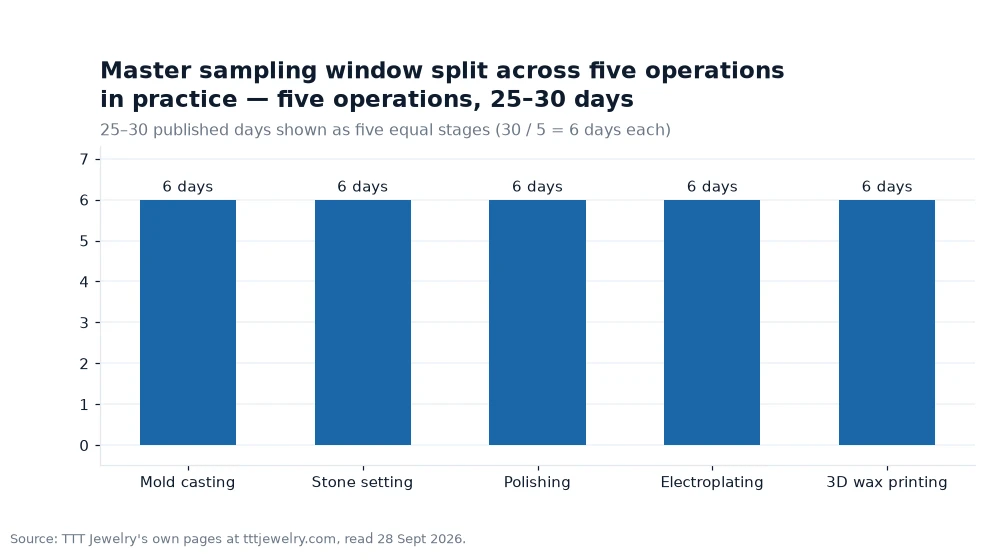
Sampling is published at 25–30 days and covers wax printing in 3D through casting in a precision mould and stone setting to bench polishing and electroplating to spec. Read as a chain, the window is a sequence of five chances to get the reference piece wrong.
This is why the sampling stage, not the production stage, decides how good batch ten will look. Whatever is approved at the end of that window becomes the thing every later batch is matched against.
| Published item | Figure | Position in the process |
|---|---|---|
| 3D CAD model | under 48 hours | Before any metal is cut |
| Master sampling | 25–30 days | Five bench operations in sequence |
| Mass production | 3–4 weeks | After sample approval |
| Final inspection | 100% of pieces | After electroplating, before packing |
| Design exclusivity | 100% NDA | Applies to mould and CAD files |
What a buyer should ask for at the inspection gate
Ask what the inspection looks for, and ask who signs it. A China OEM jewelry manufacturer working to ISO 9001:2015 has a documented inspection stage, which means the answer is a written procedure rather than a person's habit.
The second question is what happens to a failed piece. Reject, rework or strip and replate - each has a cost that shows up somewhere in the order, and a factory that cannot describe the sequence is describing hope rather than process.
The paperwork behind the inspection claim
Three published items matter here. REACH limits on lead, cadmium and nickel, the ISO 9001:2015 standard and an audited BSCI social-compliance programme, cadmium and nickel.
None of the three inspects your order, and none of them is a substitute for the inspection stage itself. What they do is make the inspection credible on paper, which matters when a retail partner asks for documentation before listing a plated range.
Packing, labelling and the last metre of the process
Delivery is the eighth published step, and it covers branded packaging and worldwide express shipping with customs support. The packaging itself is specified much earlier, at the CAD stage, because a display backing card or a foil-stamped box constrains the dimensions of the piece.
Barcode labelling is the one item applied at the end, and it is the one that stops a shipment before it reaches a shop floor if it is wrong. Confirm the format before the batch is packed rather than after the cartons are sealed.
Questions that separate a process from a promise
Ask which stage inspection sits at, what happens to a rejected piece, and how a reorder is matched to the original. A factory running a documented process answers all three without checking with anyone, because the answers are written down.
Then ask for the compliance pack: ISO 9001:2015 for the quality system, the BSCI audit for social compliance, and the REACH materials statement covering lead, cadmium and nickel. None of those three inspects your order, and all three answer questions a retail partner will ask.
Where the minimum order quantity interacts with inspection
Small batches are inspected in full like any other, which is why the published rule says 100% of pieces rather than a sample size. On a 50-piece silver order that is 50 pieces across the bench; on a 100-piece brass order it is 100.
Small runs are also where tooling quality shows first, because a tired mould reveals itself in the corners and edges before it spoils a volume batch. A buyer who inspects a pilot closely is buying information about the next ten orders.
The companion point is that OEM/ODM programmes and inspection quality are not alternatives. Development decides what the piece should be, and inspection decides whether it was.
Worked example: what full inspection means for a minimum order
Take the silver minimum of 50 pieces per design and the published 100% inspection rule. A full check means 50 pieces pass the bench, so 100% × 50 = 50 inspected pieces, and none of them are skipped because the batch is small.
Now spread the sampling window over the five published operations. Thirty days divided by five is 30 ÷ 5 = 6 days per operation, and the fast end of the window is 25 ÷ 5 = 5 days. So each of the five stages - wax printing, casting, stone setting, polishing and electroplating - carries a five to six day allowance.
Inspection is the one stage that does not scale with the window. Whether the batch is 50 pieces or 100, the same check runs, which is why the published process keeps it fixed while the operations before it stretch.
Frequently asked questions
Is every piece inspected before delivery?
Yes. The published rule is 100% inspection, run as the seventh of eight stages, after electroplating and before branded packaging and shipping.
What does REACH compliance cover?
The materials statement restricts lead, cadmium and nickel, and the published plating claims are described as compliant with REACH and CA Prop 65 standards.
How long does sampling take before production starts?
Master sampling is published at 25–30 days and covers five operations: 3D wax printing, mould casting, stone setting, polishing and custom electroplating.
Two questions that improve a delivered batch
Ask which stage the inspection happens at, and ask for the master sample to be kept sealed as the reference. Both answers reduce the chance that a delivery is judged against a memory rather than a piece. The manufacturer's own answers cover the inspection and shipping arrangements, and the wholesale terms explain how repeat batches are quoted once a design is tooled.
The published detail behind this piece — a production window of 3–4 weeks as well as the anti-tarnish coating for silver and laser engraving for logos — sits on the supplier's own site via tttjewelry.com, which I read through on 28 Sept 2026. No figure above is estimated. The restating of the windows is my own arithmetic[1].